When the ground holds
On solidarity, the unlived life, and what it means to show up

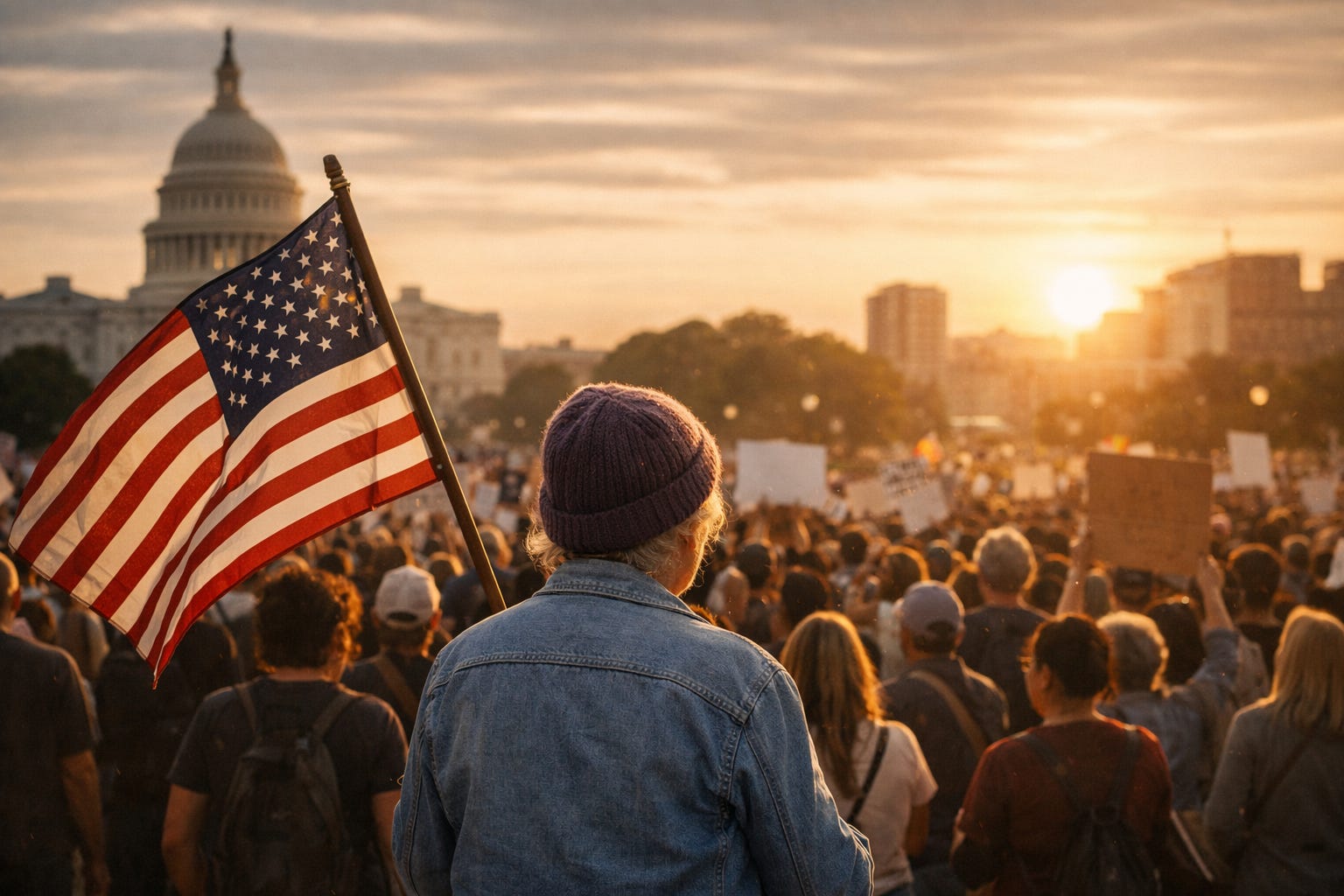
Something arrived in my awareness early this morning, before I had checked any news or opened any window. A particular gathering feeling, as if something had already organized itself in the hours before I woke. By the time I looked at my phone, I understood. Thousands of gatherings were already forming across the United States and around the world, in cities, suburbs, and small towns that almost never see a crowd, each part of the third No Kings demonstration. And I am here in Querétaro, watching from a distance that clarifies rather than separates.
James Hollis speaks often about what he calls the unlived life, the accumulated weight of what we have known to be true but have set aside, managed, or swallowed for the sake of keeping things manageable. That weight does not disappear. It gathers pressure, organizing itself in dreams, in physical sensation, in the restlessness that shadows us through ordinary days. And at some point, when enough has gathered, it moves. Something genuine emerges, something that has waited long enough and finally found a direction.
What is unfolding in the streets today feels like that kind of movement. Something past the threshold of patience, past the comfortable fiction that things will sort themselves out if we simply tend our own gardens. The people marching in Philadelphia, St. Paul, San Francisco, Fort Myers, and hundreds of other cities are having something more than a political experience. They are having a psychological one. The body asserting what it knows to be true. The self stepping across a threshold it has been eyeing for months.
Carl Jung understood that individuation, the process of becoming genuinely oneself, is never a purely private undertaking. The individual psyche is embedded in the collective, and what happens in the culture happens inside us as well. When the structures that carry human dignity and democratic participation come under sustained pressure, the psyche registers it, as something embodied rather than abstract, as something that interrupts sleep, as a knowing that surfaces beneath ordinary tasks. Many of the people in the streets today have been living with that knowing for some time. What they are doing is giving it form, direction, and company.
Joseph Campbell was careful to distinguish the hero’s journey from acts of individual ambition. The call to adventure is almost always a call toward something larger than the self. It carries risk. It requires crossing a threshold into unfamiliar territory. And it comes most often to people who arrived at the threshold through the gradual accumulation of something they could no longer set down, who are there because the call grew too insistent to decline, and because standing still had started to carry its own cost. Many of the people showing up today would say exactly that. They are answering something that kept asking, and they finally said yes.
I want to say something to those who are holding this moment without visible expression. Circumstances vary in ways that are real and worth honoring. Job vulnerability. Immigration status. Health limitations. Fear with legitimate roots. Family dynamics that make public visibility genuinely costly. To those people: private solidarity is real solidarity. The person who sits with this moment honestly, who speaks one true sentence to one other person, who refuses the inner accommodation that says everything is acceptable when everything is not, who makes a modest donation, who simply stays awake to what is happening rather than looking away, that person is also answering the call. Aquí estamos, we say in México: here we are. You can be here from wherever you stand. The presence this moment asks for begins inside before it takes any outward form at all.
From Querétaro, I watch the United States with the particular attention of someone who has left it. That distance carries warmth rather than cold. It is more like stepping outside a room to see the whole building. What I see is people in motion. An 81-year-old woman who marched against the Vietnam War, still marching. Young parents who brought their children so that the children would one day remember they were there. Artists and teachers and workers and retirees who decided that something was being asked of them and chose to answer it. I find myself more moved by this than I anticipated, with the recognition of someone who loves the country he left and watches it now with deep, sustained attention.
The work I do with individuals, and the themes at the center of A Life Aligned, return consistently to one idea: that alignment between what we know inwardly and how we live outwardly forms the foundation of a life that feels genuinely real. That principle asks something of us, repeatedly, in the large moments and the ordinary ones alike. It is also the source of the energy that makes a person feel alive in the full sense, the energy that comes from living in consonance with oneself rather than in managed distance from what one actually knows.
Today, many thousands of people are living in consonance with themselves in public. The rest of us are working out how to do the same from wherever we are standing.
Whatever this day means to you politically, I hope it opens the deeper question. Where in your own life is the unlived thing still pressing? Where has the call been growing more insistent? What threshold have you been standing before, weighing the cost of crossing? Those questions do not require a march. They require honesty, and the willingness to let that honesty have some consequence in your daily life.
I am proud of everyone who showed up today, in whatever form showing up took. That includes you, wherever you are reading this.
— Mark
A Life Aligned is a guide to the inner work of living more intentionally. Available in paperback, eBook (Amazon, Apple Books, Barnes & Noble, Kobo, and others), and audiobook.
Dr. Mark Arcuri is a psychology professional, integrative coach, educator, and author based in Querétaro, México. He is Associate Dean of the BS Integrative Health program at Walden University and sees clients in private practice.
If this essay found you at the right moment, consider sharing it with someone for whom it might do the same.
I would love to hear from you this week. Whether you were in the streets today, watching from home, or somewhere else entirely, what does this moment bring up for you? What does it ask? Reply whenever you are ready.
I live in the UK and totally support the protest. My heart walks with them. Great to find you here Dr. Arcuri, I am loving your book. About halfway through now.